
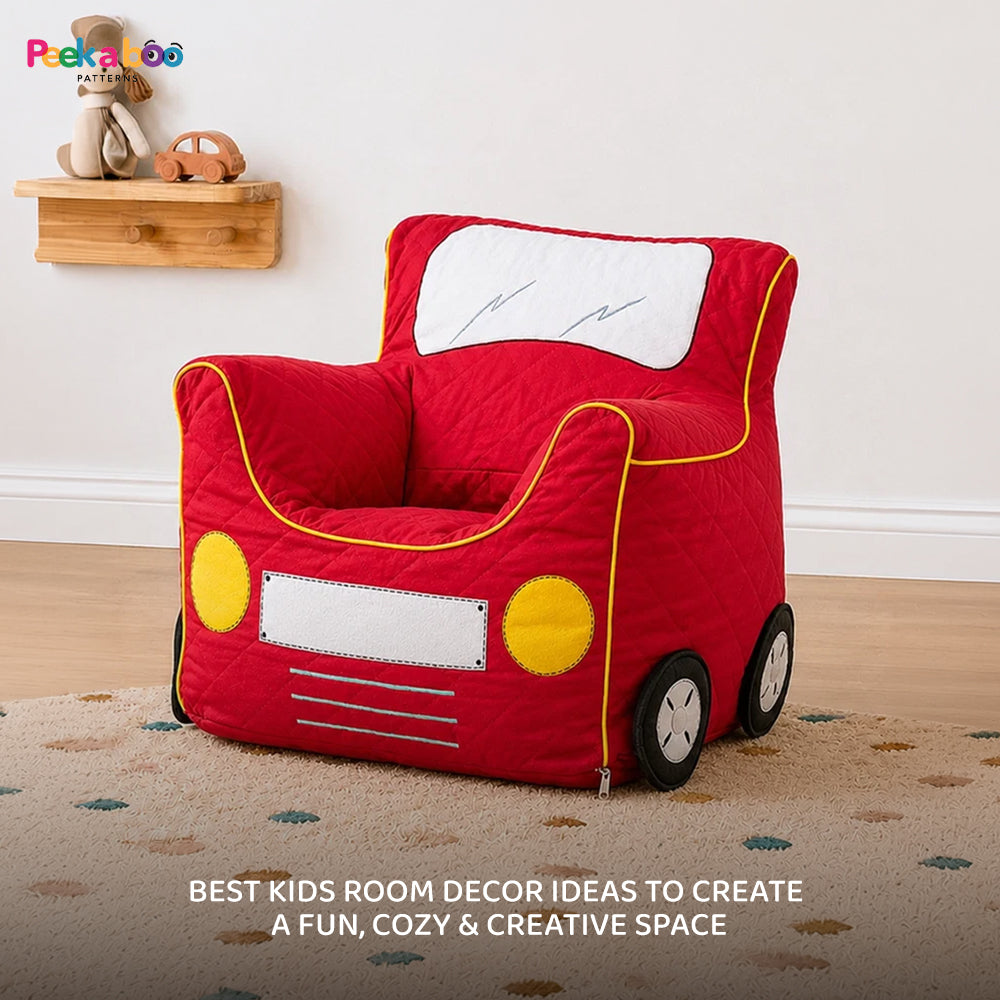
Best Kids Room Decor Ideas to Create a Fun, Cozy & Creative Space
A child's room usually has to do several jobs at once. It needs to hold toys, books and clothes, leave enough space for play, and still feel calm enough for bedtime. That's a lot to ask of one room, which is probably why so many parents end up googling kids room decor ideas at 11pm with a cup of tea going cold beside them.
The good news is that you don't need to gut the room or hire a designer to get it right. Most of the difference comes from a handful of decisions — the theme, the wall, the seating, the storage — made thoughtfully instead of all at once. This guide walks through those decisions one at a time, with practical suggestions you can actually use, whether you're setting up a nursery or reworking a nine-year-old's bedroom.
Start With a Theme That Can Grow With Your Child
It's tempting to go all-in on a theme your toddler loves this month — dinosaurs, a specific cartoon, a particular colour. The trouble is that three-year-olds change their minds fast, and a room that's too literally themed can feel dated within a year.
A more durable approach is to pick a broad idea rather than a specific character. Think jungle and animals, space and stars, the ocean, nature, or a simple rainbow palette. These themes are flexible enough to grow with a child from toddlerhood into the early school years, and they're easy to update with small changes rather than a full redo.
If you're not sure which way your child's tastes will go — or you're decorating before the baby even arrives — a gender neutral kids room idea built around nature, animals or soft colour blocks tends to age the best. You can always layer in more specific interests later through cushions, wall art or bedding, which are far easier to swap than furniture or paint.
Create a Fun Feature Wall
You don't need to paint every wall in the room to make it feel decorated. One feature wall does most of the work, and it's one of the simplest kids room decoration ideas to execute without much cost or disruption.
A few directions that work well:
-
A gallery of framed prints or your child's own artwork
-
Fabric bunting strung along the wall in a theme that matches the room
-
Wall decals or stickers in a jungle, space or nature motif
-
A mix of educational posters — the alphabet, a map, the solar system — alongside decorative pieces
Bunting in particular is an easy win for kids bedroom decor ideas. It adds colour and softness to a wall without needing paint, drilling or a big budget, and it can be moved from one spot to another as the room evolves. Peekaboo Patterns' bunting collection has a few playful prints that work well strung above a bed or across a play corner.
Try to leave some breathing room on the wall too. A wall that's completely covered edge to edge can start to feel busy rather than fun, especially in a smaller room.
Add Comfortable Seating With Cushions or Bean Chairs
An empty corner is wasted space. Add one comfortable seat and it becomes something — a spot to read, a place to sit during playtime, or somewhere your child goes to calm down after a big day.
Floor cushions and bean chairs are especially good for this because they don't need much floor space, they're easy for a child to sit on and get up from independently, and they add colour without needing new furniture. A single bean chair in a corner, paired with a floor cushion or two, can transform an unused patch of carpet into the room's favourite spot.
Peekaboo Patterns' bean chair covers come in a range of prints — jungle animals, traffic themes, florals — so it's usually possible to find one that ties in with whatever theme or colour scheme you've gone with elsewhere in the room. Long cushions and shaped cushions work well here too, especially if you want extra seating that doubles as a prop for pretend play.
Make a Dedicated Reading Corner
A reading corner doesn't need to be elaborate. At its simplest, it's a comfortable place to sit, a few books within reach, and decent light.
A workable formula:
-
A bean chair or a couple of floor cushions for seating
-
A small shelf or a low basket where books are visible and easy to reach — not stacked in a cupboard
-
A soft rug or play mat underfoot
-
A lamp or reading light, since overhead lighting is rarely ideal for reading
The location matters more than people expect. A reading corner tucked into a busy walkway rarely gets used, while one placed near a window or in a quiet corner of the room usually does. If your child is old enough to choose their own books, keeping the shelf at their height — rather than yours — makes a real difference to whether the corner actually gets used or just looks nice.
Use Storage That Looks Like Part of the Decor
Storage is where a lot of kids room decor ideas fall apart in practice. It's easy to picture a beautifully styled shelf, harder to keep it that way once the toys, books and art supplies pile up.
The fix isn't more storage — it's storage that's actually easy to use. Open shelves work better than closed cupboards for younger children, simply because they can see what's inside without asking for help. Baskets and soft storage bins are useful for grouping similar things together — building blocks in one, soft toys in another — without needing a rigid filing system.
A few practical habits help too:
-
Keep frequently used toys at a child's height, and rotate out the rest
-
Use labels — pictures for younger kids, words for older ones — so tidying up doesn't require you
-
Reserve one shelf or basket purely for the day's "current favourites," so cleanup feels manageable rather than overwhelming
-
Vertical storage (tall, narrow shelving) is often more useful than wide, low units in a smaller room, since it uses height instead of eating into floor space
Soft storage baskets are a small addition that make this system easier to stick to — they're lighter for a child to pull off a shelf than a rigid box, and easier to toss toys back into at the end of the day.
Good kids room storage ideas tend to be boring in the best way — they just work, day after day, without needing to be reorganised every week.
Create a Play Zone Without Taking Over the Room
Most rooms don't have space for a separate playroom, so the play zone has to share space with the bed, the storage and everything else. The trick is to define the zone clearly, even if it's small.
A play mat is one of the simplest ways to do this — it visually marks out where play happens, cushions the floor, and can be rolled up when you need the space for something else. A teepee tent works similarly but adds a sense of enclosure that a lot of kids genuinely love, giving them a small space that feels like their own within the bigger room. Peekaboo Patterns' play mats and tents are worth a look if you're setting up a corner like this.
Keep the play zone's boundaries loose but consistent — a rug, a mat or even furniture placement can mark where it starts and ends, which helps children (and parents) know where toys belong when it's time to tidy up.
Choose Decor Based on Your Child's Age
Kids Room Ideas for Babies
A nursery generally needs to prioritise calm over stimulation — soft colours, gentle patterns, and decor that supports sleep rather than distracts from it. Nursery room decor ideas usually centre around a crib, a comfortable nursing or feeding chair, and simple, soothing wall decor. A soft mobile hanging above the crib is one of the few decor pieces that also doubles as gentle visual stimulation for a baby. Anything with small, detachable parts should be kept out of the crib area for safety.
Kids Room Ideas for Toddlers
Once a child is mobile and curious, accessibility becomes the priority. Storage should be low enough to reach, play areas should be clearly defined, and soft furnishings — cushions, mats, bean chairs — matter more than delicate décor pieces. Toddler room decor works best when it's simple, sturdy and forgiving of a lot of hands-on exploring.
Kids Room Ideas for School-Age Children
By the time a child starts school, the room usually needs to do more — a study corner, a reading area, and storage for books, stationery and school bags, alongside the play space. A simple activity table and chair set, sized for the child rather than borrowed from the dining room, tends to get used far more consistently than a desk that's too big. This is often when kids bedroom ideas start to reflect the child's personality more directly, through their choice of colours, posters or a hobby-based theme.
Kids Room Ideas for Older Children
As children grow older, it's worth giving them more say in how the room looks — the colour palette, the accessories, even which wall art goes up. A room that reflects a child's own taste, rather than one chosen entirely by a parent, tends to get looked after better and used more happily.
Kids Room Decor Ideas for Small Rooms
Small rooms need a slightly different approach, and it's one of the most common things parents search for. A few things genuinely help:
-
Go vertical. Tall shelving and wall-mounted storage use height instead of floor space, which matters enormously in a compact room.
-
Keep the floor as open as possible. Fewer freestanding pieces means more room to actually play.
-
Choose multifunctional furniture where you can — a storage ottoman, a bed with drawers underneath, a chair that also holds toys.
-
Stick to one feature wall rather than decorating every surface, so the room doesn't feel cluttered visually even if it's compact physically.
-
Create zones instead of separate rooms. A play mat in one corner and a reading cushion in another can define different "areas" without needing extra square footage.
-
Use baskets over boxes with lids. Anything a child has to open and close slows down tidying and play alike.
Small kids room ideas work best when every item earns its place. It's less about fitting more in and more about making sure what's there is genuinely used.
Mix Colours, Patterns and Textures
A colourful room doesn't need every colour in the crayon box. A simple, workable approach is to choose one dominant colour for the walls or main furniture, one supporting colour for secondary pieces, and one accent colour used sparingly — in cushions, bunting or small decor items.
This is where soft furnishings do a lot of quiet work. Cushions, bunting, floor mats and bean chair covers are an easy way to bring in pattern and colour without repainting or buying new furniture, and they're just as easy to change again later if tastes shift. Shaped cushions — a star, a car, a castle — are a fun way to introduce an accent colour without it dominating the room. If you want to experiment with kids room colour ideas without committing to anything permanent, this is the lowest-risk way to do it.
Create a Room That Reflects Your Child's Personality
Once the basics — theme, storage, seating — are sorted, the room starts to feel truly theirs when it reflects what your child actually likes. That could be animals, space, a sport, books, art, or nothing in particular beyond a favourite colour.
Small, personal touches go further than people expect: a shelf of favourite books left visible rather than tucked away, artwork displayed rather than filed, a cushion in a print tied to something they're currently obsessed with. None of this needs to be expensive or permanent — it just needs to reflect the child who actually lives there.
How to Decorate a Kids Room on a Budget
Budget kids room ideas work best when you spend on the things that get used and touched daily, and skip the things that only look good in photos.
A few realistic, low-cost changes:
-
Swap cushion covers instead of buying new furniture
-
Add one or two pieces of wall decor rather than redoing the whole wall
-
Rearrange existing furniture before buying anything new — sometimes a fresh layout does more than a fresh purchase
-
Rotate toys in and out of storage so the room feels different without adding clutter
-
Use baskets to organise what you already have, rather than buying new storage systems
-
Pick one statement accessory — a bean chair, a set of bunting, a play mat — rather than trying to update everything at once
-
Let your child help make simple DIY artwork for the walls
None of these require a big budget, and done together, they can noticeably change how a room feels.
7 Common Kids Room Decorating Mistakes to Avoid
Choosing a theme that is too specific
A room built entirely around one character or one very narrow interest tends to feel outdated fast. Broader themes last longer and are easier to update.
Using too many colours
More colours don't automatically mean more fun — they can just make a room feel chaotic. A dominant colour with one or two supporting shades usually reads as more cheerful, not less.
Ignoring storage
Decor that looks good but doesn't solve where things actually go tends to fall apart within weeks. Storage should be planned alongside the decor, not as an afterthought.
Filling every empty wall
Empty space isn't wasted space. A wall left partly bare often makes the decorated parts stand out more.
Buying furniture children quickly outgrow
Furniture sized for a very specific age can be outgrown within a year or two. Where possible, choose pieces that adapt — adjustable, simple, and not overly tied to one age group.
Prioritising looks over functionality
A beautifully styled room that's hard to actually use — storage too high, seating too formal, decor too delicate — rarely stays that way for long. Functionality should come first, decoration second.
Forgetting the child's preferences
It's easy to decorate a room the way a parent likes it. But a room a child actually enjoys is one they had some say in — even in small ways.
FAQ’s
How can I decorate my child's room?
Start with a flexible theme, add one feature wall, include comfortable seating, and set up storage that's easy for your child to use independently. Layer in personality through cushions, wall art and accessories rather than big furniture changes, and involve your child in the smaller decisions where you can.
What are some simple kids room decoration ideas?
Bunting on one wall, a few framed prints or your child's own art, a bean chair or floor cushions in a corner, and a rug or play mat to define a play area. None of these require major renovation, and together they make a noticeable difference.
How can I decorate a small kids room?
Focus on vertical storage, keep the floor open, choose one feature wall instead of decorating every surface, and use baskets rather than boxes with lids. Multifunctional furniture and clearly defined zones — rather than separate rooms — help a small space feel more organised.
What should I put in a kids' room?
At minimum: a bed, accessible storage for toys and clothes, a comfortable seating spot for reading or play, and some wall decor that reflects your child's interests. Beyond that, additions like a play mat, bean chair or tent depend on the room's size and your child's age.
How do I make a kids room look cozy?
Soft furnishings do most of the work — cushions, a rug or play mat, warm lighting instead of harsh overhead light, and a defined seating spot such as a bean chair. Cozy usually comes from texture and comfort, not from adding more decor.
What are the best kids room themes?
Broader themes tend to work best long-term — jungle and animals, space, nature, the ocean, or a simple colour-based palette. These are flexible enough to suit changing interests and are easier to update gradually than a very specific, character-based theme.
How can I organize toys in a kids room?
Use open shelves and baskets rather than closed cupboards, so children can see and reach what they need. Group similar toys together, label storage where possible, and rotate toys periodically so everything doesn't need to be out at once.
Where can I buy kids room decor online in India?
Peekaboo Patterns offers a range of kids room decor online, including cushions, bean chairs, bunting, play mats and tents, along with kids furniture, designed for Indian homes and delivered pan-India.


Leave a comment
This site is protected by hCaptcha and the hCaptcha Privacy Policy and Terms of Service apply.